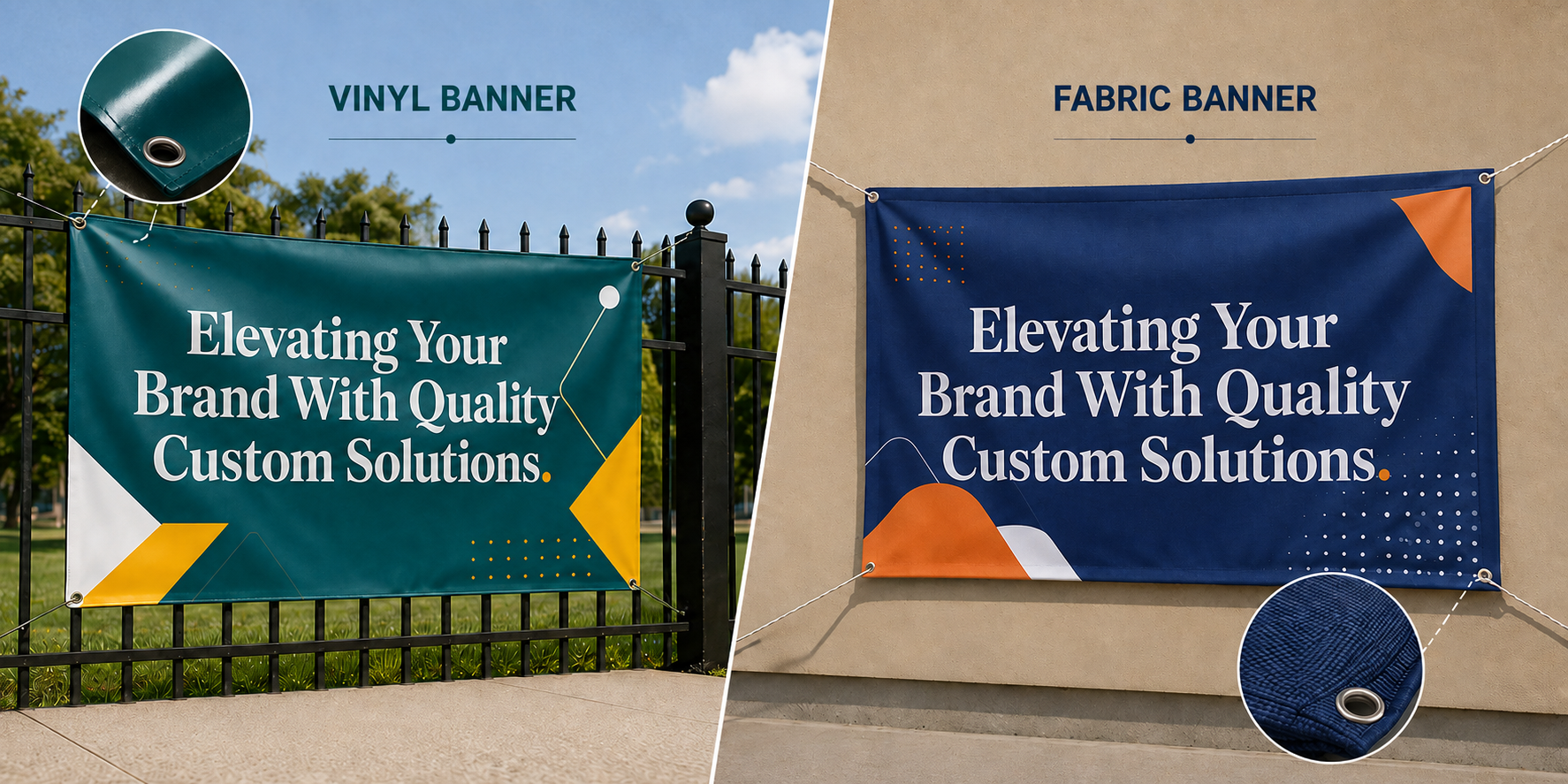

Outdoor Banner Printing: A Complete Guide to Materials, Durability & Weather Consideration
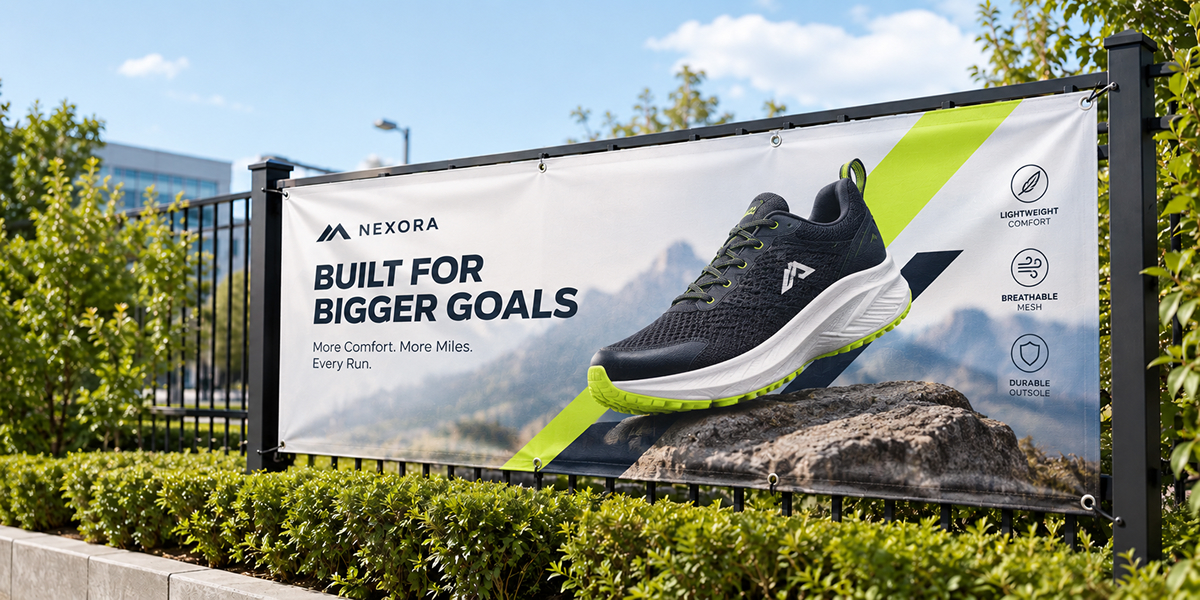
Outdoor banner printing has different sets of demands other than just creating the graphic for display. After taking the banner out into the open air, the print will have to endure the effects of UV rays, heat, rain, moisture, wind, and physical strain. An image that may look perfect from the printing machine will be subjected to the elements outdoors for weeks or even months.
This means that designing a custom outdoor banner is no longer about choosing an image but rather about matching the construction of the banner to its surroundings. The fence could be constantly subjected to wind pressure, whereas the storefront banner could be facing mostly sunlight and rain. The large outdoor banner increases the surface area, whereas the vinyl mesh banner allows for airflow in areas where there would be increased wind pressure on the solid surface.
The following four factors play an essential role in determining how the outdoor banner will function over time:
- Banner Material
- Printing Method
- Finishing
- Environmental Exposure
The guide provides insight into what constitutes durable outdoor promotional banner printing, making you aware of how the weather influences material, construction, and the printing process.
What Makes an Outdoor Banner Weather Resistant?
Resilience to weather depends on the effectiveness of the material used in the banner to withstand the outdoor environment. The sun impacts the color and integrity of the surface, while water tests the substrate and finished edges, and wind exposes the banner to constant stress. A dependable custom outdoor banner requires resilient qualities.
Advanced Material Composition
The substrate determines how well a banner handles prolonged outdoor exposure. Outdoor-grade vinyl is designed to resist moisture while maintaining flexibility and structural strength during temperature changes. Reinforced construction can also help the banner withstand repeated pulling and movement without easily tearing.
For more demanding applications, heavy-duty outdoor banners use stronger material constructions suited to larger displays, extended exposure, or environments where the banner is likely to experience greater physical stress.
Specialized Ink and Print Technology
Outdoor durability also depends on how the printed image responds to environmental exposure. Printing systems designed for outdoor applications help the graphics maintain their appearance when exposed to sunlight, moisture, and temperature changes.
This is particularly important for outdoor banner printing, where a banner may remain exposed for weeks or months. A durable substrate does not automatically guarantee long-lasting graphics if the printing system is not appropriate for outdoor conditions.
Moisture Resistance
Rain and humidity can repeatedly expose a banner to water, making moisture resistance an important consideration. Vinyl surfaces naturally provide a strong barrier against water, helping prevent the substrate from absorbing moisture during outdoor use.
However, prolonged exposure still places additional stress on edges, seams, and attachment areas. This is why a weatherproof vinyl banner needs to be evaluated as a finished product rather than based only on whether its surface is water-resistant.
UV Resistance
Continuous sunlight can gradually affect outdoor banners, particularly when they remain exposed for long periods. UV radiation can contribute to fading and deterioration of the banner surface, making UV resistance important for displays placed in direct sunlight.
For large outdoor banners, this becomes even more relevant because the display may have substantial surface exposure throughout the day. Suitable outdoor printing and UV-resistant materials can help maintain the banner's visual quality over longer periods.
Resistance to Tearing and Stretching
Wind creates repeated pulling and movement across an outdoor banner. Over time, this mechanical stress can affect the material, particularly around corners and attachment points.
A strong banner substrate should resist excessive stretching while remaining flexible enough to handle movement. Reinforced edges and appropriate finishing can further distribute tension across the banner, which is especially useful for heavy-duty custom vinyl banners used in exposed locations.
Weather Resistance Is a Combination of Properties
No single feature makes a banner weather-resistant. Its outdoor performance depends on how well the substrate handles moisture and physical stress, how the printed graphics respond to sunlight, and how the finished banner holds together during repeated exposure.
The right specification therefore depends on the environment, exposure period, and level of physical stress the banner is expected to handle. This becomes particularly important when choosing between solid vinyl, vinyl mesh banners, and heavier outdoor constructions for specific applications.
How Different Weather Conditions Affect Outdoor Banners
When investing in outdoor banner printing, your signage needs to fight nature all day long. Therefore, knowing how these particular weather elements react with the material, ink, and hardware of the banners is the most important thing to do before choosing the correct banner.
1. UV Exposure and Direct Sunlight
- Ink Degradation: The ultraviolet radiation disintegrates the bonds within conventional ink, leading to quick fading of color.
- Brittleness of Material: Prolonged UV light exposure removes plasticizers from the PVC, making it brittle and hard.
- Glare and Legibility: Bright sunlight eliminates any text that lacks good contrast.
- Surface Peeling: Graphics printed on uncoated substrates may dry out, blister, and peel off.
2. Heat and Temperature Fluctuations
- Material Stretching: In hot summer weather, PVC gets softer, due to which solid banners become loose and wrinkled.
- Thermal Expansion: Repeated exposure to hot and cold weather results in micro-tears on the rigid mounts.
- Sub-Zero Cracking: The low temperatures make the vinyl brittle and likely to break under sudden pressure.
- Adhesive Failure: Excessively high temperatures degrade the glue used in the banner tape, leading to the separation of the folds.
3. Rain, Humidity, and Moisture
- Growth of Mildew: Moisture trapped in poorly ventilated areas grows mold that stains the white material and spoils the designs.
- Stitch Rot: Water gets into the threads stitched conventionally, rotting the fibres and making the stitches fall apart.
- Weight Problem: Water collection on hanging banners puts enormous strain on the structure of the banner frames.
- Bleeding of Ink: Water-soluble or low-quality ink will smear and spread in the event of heavy rainfall.
4. Wind and Mechanical Stress
- Acts Like Sails: The solid vinyl material picks up the rapidly moving air currents just like a parachute would, thus creating a pulling force of several hundred pounds on the vinyl fence banner.
- Tears Out Grommets: Whipping forces cause highly concentrated mechanical stress at certain spots, tearing out the metal rings from custom outdoor banners.
- Unravels Raw Edges: High-frequency fluttering quickly deteriorates and unravels the unfinished edges on heavy-duty custom vinyl banners.
- Scratches Inked Faces: Sand that is whipped up by wind scratches away the protective layer of ink that has been printed on outdoor banners.
5. Freezing Temperatures
- Freezes Vinyl Rigid: Extremely low temperatures remove material flexibility, making a regular heavy-duty outdoor banner rigid like glass.
- Rips Easily Under Stress: Frozen vinyl rips easily under stress or sudden wind gusts unless you use a vinyl mesh banner.
- Heavy Ice Traps: Rain and snow freeze into thick ice layers on horizontal pole banners and structures.
- Crack Folded Hems: Cold weather creates cracks in the folded ends of the hem, leading to cracks in outdoor promotional banners.
Outdoor Banner Materials: What Performs Best Under Different Conditions?
What kind of material should be used for outdoor banner printing? This question can only be answered by considering the environmental stresses that the material must endure after the banner has been put up. There are times when advertising banners would be required for a sheltered storefront and other times when they would be needed for an exposed construction fence. However, the two are not similar in terms of environmental requirements. It is therefore much better to examine the performance of each fabric in certain situations.
Solid Vinyl for General Outdoor Exposure
Regular solid vinyl (13 oz to 15 oz) represents the basic material used in outdoor signs. This is because it ensures an uninterrupted printing area that delivers great visual contrast, clear lettering, and deep color penetration. Since solid vinyl blocks 100% of light transmission, it is very efficient in double-sided applications, provided it incorporates a blockout core. But because of its total solidity, it ensures maximum wind resistance, which means that it can only be applied on a flat surface that does not allow the wind to blow through it.
Vinyl Mesh for Wind-Exposed Areas
Vinyl mesh banners are considered best for open structures, fencing, and high-altitude structures. These banners are usually made using a 70/30 weaving method. The result of such a weaving method produces very small holes, which ensure that 30% of the air goes directly through the banner while the graphic occupies 70% of the total surface. Vinyl mesh fence banners minimize the risk of “sail effect” and ease structural stress, making them perfect for high-wind geographic locations.
Heavy-Duty Vinyl for Demanding Applications
For installations that need extreme durability, weight ranges can rise from 10 oz or more to 18 oz or even 22 oz. Heavy-duty custom vinyl banners employ a lot heavier internal polyester weave (high denier count) and thicker external PVC coatings. Such materials are designed specifically to withstand heavy physical abuse, extremely low temperatures, and continuous exposure for many years. They are more resistant to punctures, stretching, and tears compared to lighter versions.
Eco-Friendly Options for Outdoor Displays
With growing sustainability measures in corporations, the advent of Eco-friendly outdoor banners offers an option to traditional PVC banners in the form of high-performance materials. These eco-friendly substrates are commonly made using 100% recyclable polyolefin or biodegradable polyester materials. They are completely free of PVC, which means that there is no danger of any chlorine or plasticizer leaching into the environment, and at the same time, they carry similar coatings to their traditional counterparts.
How Does Wind Affect Outdoor Banner Construction?
The wind creates constant pressure on an outdoor banner, and the force gets stronger with the increase in the size of the banner or the installation of the banner in open areas. The factors to be considered are:
- Surface Area: A large outdoor banner will have increased surface area subjected to pressure due to wind.
- Material Stress: The solid vinyl material cannot let air pass through. Therefore, the stress on the banner and its edges will increase due to continued exposure to wind.
- Attaching points: A custom banner with grommets and other attaching points acts as a stress absorber for the force caused by the wind blowing at the banner.
- Perforation of Air: The vinyl mesh banner lets air flow through its perforated body, thus making its pressure equal throughout. This feature makes the vinyl mesh banner ideal for fences, construction fences, and exposed structures.
- Wind Flaps: A custom vinyl banner with wind flaps is one that lets a certain amount of air out while maintaining a relatively solid body of print on the banner.
Outdoor Banner Finishing for Greater Durability
Options for finishing will be helpful in reinforcing the banner in the places where it experiences the most outdoor stress. It depends on many factors such as exposure to wind, the method of hanging, time of display, and weather.
Reinforced Hems
Reinforced hems help to reinforce the edges of the banner and avoid stretching or tearing because of wind and pressure when they are used regularly. They are particularly used for heavy-duty custom vinyl banners or large outdoor banners.
Grommets
Grommets are reinforced holes that assist in distributing the tension on the banner. A custom banner with grommets is ideal for use in applications that require fixing points all along the edge of the banner.
Pole Pockets
Custom vinyl banners with pole pockets provide a reinforced pocket through which poles or rods can pass. This helps in spreading the weight and tension of the banner along a wider area instead of concentrating them to specific points.
Wind Flaps
Wind flaps make holes in the solid vinyl, which allows some air to pass through it to alleviate any pressure on the banner when there is wind. A custom vinyl banner with a wind flap can be selected in case there is a need for a solid printed surface rather than a mesh one.
Lamination
The process of laminating adds protection on top of the printing, which is done in order to protect the graphics from water, scratches, and other outside elements. Lamination can serve as another element to consider for weatherproof vinyl banners that will be left outside for long periods of time.
For banners that are exposed to demanding conditions, Printing Limitless’ custom outdoor banner options will help you to choose as per the intended application.
How Does Printing Affect Outdoor Banner Longevity?
One common mistake in commercial signage is believing that if one purchases a heavier substrate, the sign will automatically last longer. But if the printed message becomes illegible after a few weeks, there will be no point in having purchased a substrate that will last a lifetime.
Formulation of Ink
UV-cured ink or eco-solvent ink formulation is used for weatherproof vinyl banners, as opposed to the conventional ink made from water-based pigments. These inks are made up of top-quality colors that rate highly on the Blue Wool Scale.
The Photopolymerization Process
In outdoor banner printing, the UV ink, which is in the liquid state, is subjected to instant bombardment of ultraviolet rays from ultraviolet lamps on the print head. This leads to quick chemical reactions where the monomers cross-link to form a plastic skin.
Ink Adhesion and Substrate Flexibility
The advanced ink used is designed in such a way that it maintains its elastic nature once cured. This means that the ink will stretch and bend along with the flexible vinyl banner at varying temperatures.
Print Resolution & Ink Density
When printing with optimum print resolution and ink saturation, a dense coating of pigment will be produced. The dense coat will ensure that although the outer coating molecules will degrade over time, the clarity of text and contrast in your outdoor advertising banner will remain unchanged.
Over-Lamination and Liquid Coating
The application of an additional clear coating or lamination forms a chemical shield that is invisible on top of the printed material. The protective coating shields the printing from harmful UV rays, acid rain, and any form of scratches or debris on the road.
Quick Comparison: Print Technology Longevity
| INK TYPE | OUTDOOR LIFESPAN (Unlaminated) |
PRIMARY STRENGTH | BEST OUTDOOR APPLICATION |
|---|---|---|---|
| UV-Curable | 3 – 5 Years | Superior scratch resistance |
Rigid signs, mesh banners, high-volume prints. |
| Eco-Solvent | 3 – 5 Years | Deep substrate integration |
High-vibrancy graphics, vehicle wraps, solid vinyl. |
| Latex | 2 – 3 Years | Excellent elasticity and eco-friendly |
Short-to-mid-term retail displays, event banners. |
Outdoor Banner Performance by Installation Environment
Banner performance can greatly vary depending on the location where the banner is mounted. These factors can expose the banner to various stresses, and thus the specifications of custom outdoor banners can vary in different locations.
1. Fences and Construction Barriers
Banners attached to chain-link or temporary fences will encounter a constant, multidirectional wind force.
- The Threat: Wind loading will create a huge sail area, causing bending of the fence and breaking of the zip ties.
- Solution: Vinyl Mesh Banners (8 oz to 10 oz)
- Why it works: The perforation allows air to flow directly through the banner, thus decreasing wind resistance by about 30%. This is done without affecting the graphic on display.
2. Building Exteriors and Brick Walls
Flush-mounted banners receive good support; however, they endure extremely harsh conditions in terms of heat and stress.
- The Threat: Heat is reflected back by bricks or concrete, and any moisture retained by the banner causes mold.
- Solution: Heavy-Duty Solid Vinyl (15 oz to 18 oz)
- Why it works: There is no need for wind filtration due to the solid wall. The thick scrim vinyl has the strength needed to keep the large outdoor banners tight and wrinkle-free
3. Street Poles and Light Posts
Suspended vertical banners are especially susceptible to torque, twisting, and whipping caused by traffic flow.
- The Threat: Twisting puts stress on the small connection areas at the top and bottom ends.
- Solution: Double-Sided Blockout Vinyl (18 oz+)
- Why it works: No ghosting (the image bleeding through from the other side in sunlight) due to the blockout material being thick enough. Using a custom vinyl banner with pole pockets rather than grommets ensures the banner goes onto the poles, thus equalizing the wind force across the width of the frame.
4. Roadside and High-Traffic Corridors
Highways or areas with fast-moving traffic are subjected to constant turbulence and debris.
- The Threat: Fast-moving wind wake formed by semi-trucks, combined with dust, dirt, and road salt, causes physical abrasion of the print.
- Solution: Premium Solid Vinyl (18 oz) with UV-Curable Ink and Clear Lamination
- Why it works: The heavy material is resistant to damage caused by the presence of small rocks, and the clear laminate helps wash away road dirt without washing off the inked banner.
Comprehensive Outdoor Banner Comparison
| MATERIAL TYPE |
WEIGHT CLASS |
BEST INSTALLATION ENVIRONMENT |
KEY LIFESPAN CONSIDERATIONS |
EXPECTED LIFESPAN |
|---|---|---|---|---|
| Standard Vinyl |
13 oz – 15 oz |
Light promotional displays, retail fronts |
Moderate exposure and normal weather conditions |
1 – 2 Years |
| Vinyl Mesh | 8 oz – 10 oz |
Chain-link fences, construction barriers |
Reduced wind pressure through airflow |
2 – 3 Years |
| Heavy-Duty Vinyl |
15 oz – 18 oz |
Building exteriors, brick walls, flat surfaces |
Greater resistance to tearing and physical stress |
3 – 5 Years |
| Blockout Vinyl |
18 oz+ | Street light poles, double-sided brackets |
Prevents light transmission between printed sides |
2 – 4 Years |
| Laminated Heavy Vinyl |
18 oz+ | Highways, high-traffic corridors, extreme climates |
Added protection for graphics and printed surface |
5+ Years |
Match Your Custom Banner Needs With Outdoor Conditions
Outdoor banner longevity does not depend solely on its material. It should be chosen based on environmental factors like sun, water, temperature fluctuations, wind, and physical strain the banner will be exposed to. The outdoor banner printing process should also be selected depending on the environment to retain graphic quality.
Solid vinyl is generally an appropriate choice for outdoor usage, whereas vinyl mesh banners are preferred for windy sites. Durable fabric will be suitable for large projects, while special treatments like hemming, grommeting, pole pockets, wind flaps, and lamination may be considered where necessary.
This is to ensure that the banner materials, printing process, and fabrication process are suited for the environment and not because one has to choose the heaviest or the costliest materials available. For any assistance on which specification to choose, you can visit the custom banners page at Printing Limitless.