
Standard Vinyl Banner Size Guide: Choosing the Right Dimensions
How can you be sure that a custom vinyl banner is indeed the correct size for your allotted area? Does a large banner always mean better visibility? How does using the same design on a smaller banner affect it?
The size of the banner affects how it appears and interacts with the environment. A banner design that works well for a storefront display could appear too large for an indoor event, while another could get lost in an outdoor setting due to its small size. Given the availability of many vinyl banners in various dimensions, deciding which one to select is not a simple process.
This guide focuses on the various sizes of custom-printed banners commonly considered when ordering. We’ll explore the sizes available in vinyl banners, how the dimensions of width and height determine a format, and when a particular size is not recommended.
Our objective is to assist you in having a better understanding of the right size for your banner print job, without being overwhelmed by technical aspects.
What Are the Most Common Vinyl Banner Sizes?
Banners are not always required to have unique dimensions. There are some standard measurements for banners that are enough to accommodate most of the common display needs. This helps you avoid the tedious task of switching to a completely custom size chart.
Some common vinyl banner sizes that can be seen quite often are:
- 2 × 4 feet
- 2 × 6 feet
- 3 × 6 feet
- 3 × 8 feet
- 4 × 8 feet
- 5 × 10 feet
Bigger sizes can also be provided, depending on what size is required by the design to be put up. This list includes some common sizes; however, they do not have to be considered as any set industry standards.
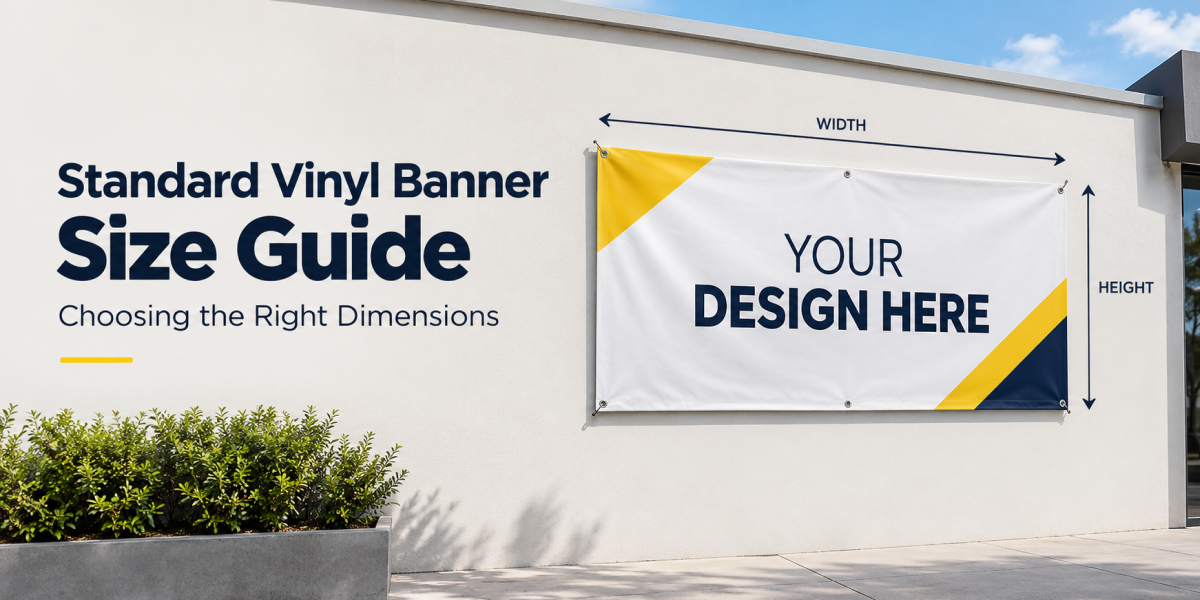
One thing that one must verify before the size comparison is how the measurements are written. Vinyl banner dimensions are generally listed as width x height. Therefore, a 4 × 8 ft banner would mean a height of 8 feet horizontal span when placed in landscape mode. However, switching the two values results in a different configuration.
This becomes very important when comparing two banners that are similar in writing but differ greatly in their effective use of space. The various sizes are described in detail below so that you get an idea of what each size means in practical terms.
Standard Vinyl Banner Size Chart
A simple size guide will help facilitate the comparison of dimensions without diving into specifics of each type. The table provided below will show standard vinyl banner sizes that are usually requested for ordering, along with their dimensions and orientation.
Note: These are some of the common dimensions. They are not industry requirements that must be met. The exact availability will depend on the particular printer used. There are also options for making personalized vinyl banners in other dimensions for particular display areas.
Popular Vinyl Banner Sizes and Their Uses
It gets easier and more feasible to look at the overall scale of the dimensions once the numbers are laid out in a vinyl banner size guide. A small and a large banner can both carry the same message, but the physical space and the distance at which they will be kept can differ significantly. This changes a lot of things in terms of dimensions.
Smaller Formats: 2’ x 4’ and Similar Sizes
Smaller common vinyl banner sizes fit well where the display area is compact or limited. Moreover, it can also work when the distance between the display and the audience is not too far. A 2’ x 4’ format, for instance, can suit storefront displays and indoor events.
Medium Formats: 3’ x 6’ and 4’ x 8’
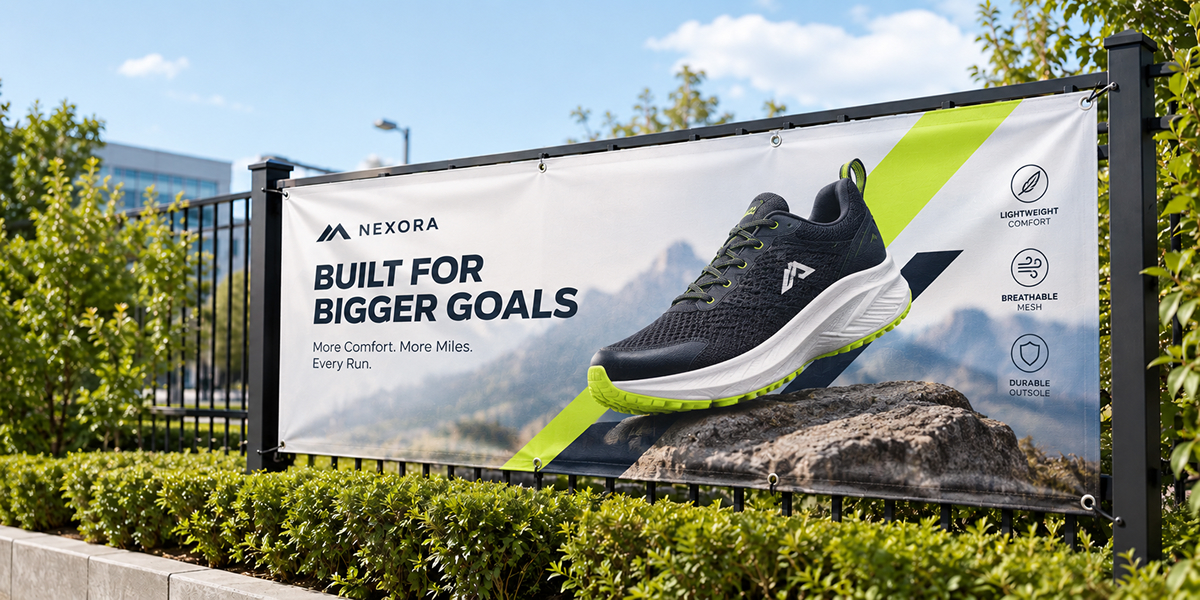
Banners of medium sizes provide an ample display area and are very portable as well. The 3’ x 6’ banner provides a longer horizontal display area that is perfect for use at various events, vendors, and marketing. If the size is increased to 4’ x 8’, then the surface area increases too and becomes perfect for use on fences, building walls, construction areas, and many more such surfaces.
Large Formats: 4’ x 10’ and 5’ x 10’
The large vinyl banner adds extra width and surface area to display items that require visibility in a bigger area. Sizes like 4’ x 10’ and 5’ x 10’ banners are ideally suited for big outdoor events, venues, properties, or even big advertising areas where small-size banners are inadequate for visibility.
Oversized Formats: Beyond the Common Banner Dimensions
When the requirement to order a banner exceeds the common format, then the project moves into an oversized or custom order. The banners can be used for covering walls, fences, stages, exhibition rooms, and any other surfaces that may require huge amounts of space. Here, things like handling and hanging of the banners and exposure to winds will become significant.
Understanding Banner Height v/s Width
The order of numbers that appear on your banner dimensions will give you an idea of how the completed banner will be oriented. In most vinyl banners, dimensions are usually shown as Width x Height (W x H), making it important to note both of them when ordering.
Reversing the dimensions creates a completely different format:
- 6’ x 3’ Banner: 6 feet wide and 3 feet high, creating a wide horizontal format
- 3’ x 6’ Banner: 3 feet wide and 6 feet high, creating a taller vertical format
All we see are the same two numbers. However, these are two entirely different banners. Both the banners have an equal amount of area on their surface, but they make use of the available area in a different way. The design made for a broad banner won’t fit into a tall banner without any modifications to its structure.
Inverting the height and width metrics can impact several key elements:
- Available design space
- Text placement
- Logo positioning
- Graphic proportions
- Overall banner orientation
This is precisely why you should always verify the width and height individually before confirming your vinyl banner printing order. This small step can prevent you from ordering the wrong size.
Landscape and Portrait Vinyl Banner Dimensions
Your choice between width and height will determine whether your banner will fall into a landscape or a portrait orientation.
- Landscape (Horizontal): Width > Height
- Portrait (Vertical): Height > Width
Landscape (Horizontal)
Landscape banners have a width larger than their height. Such a size is very efficient on horizontal surfaces. It can be used for roadside visibility, exterior walls of commercial buildings, chain-link fences, and parade banners. This is because the space available will extend from left to right. The normal sizes of landscape banners, such as 8’ x 4’ are compatible with building materials like plywood, which makes mounting exceptionally easy.
Portrait (Vertical)
Portrait banners have a height larger than the width. This helps to make them functional for vertical spaces. This dimension can be highly beneficial in indoor environments with heavy foot traffic; however, the horizontal wall space is small. They can fit in places such as next to entrances, narrow exhibition spaces, at events, or even places where a wide banner cannot fit. You can regularly find vertical dimensions like 2’ x 6’ or 3’ x 7’ housed in retractable base units.
Vinyl Banner Sizes for Indoor and Outdoor Displays
Outdoor and indoor banners do not require a distinct set of “size rules”, although the size of the area where the banner will be displayed may determine the sizes for each situation. It would be more appropriate to focus on the space that the banner must cover than to see the outdoor and indoor banners as entirely distinct types of banners.
Indoor Vinyl Banner Sizes
Indoor spaces require that sign size be strictly regulated by interior factors such as low ceiling height, narrow corridors, and lighting.
- Physical Limitations: The physical measurements of an interior space must ensure that the materials do not sag down into walkways and obstruct necessary safety signs.
- Proximity Integration: As the viewers interact with the display from arm’s length or only a few steps away, a big canvas is not necessary and might be visually overpowering the space.
- Resolution Considerations: High resolution is a key consideration for this layout type since it prioritizes the quality of detail rather than the sheer size.
Outdoor Vinyl Banner Sizes
Outdoor sign selection is completely dependent on open surroundings, broad viewing angle, and velocity of passing cars.
- Environmental Size: Signs become negligible when placed on big buildings, open parking spaces, and lengthy perimeter fences. The outdoor size needs to be considerably larger to attract attention in the unconfined environment.
- Legibility Issues: The physical size is based on the speed and distance. An exterior sign needs to be large enough that a person driving at 45 miles per hour can take the time to read the whole message safely.
- Structure Issues: Large sizes experience more resistance to wind forces as well as heaviness. When selecting an outdoor size, there has to be a balance between the size and the strength of the mounting structure.
How Viewing Distance Relates to Banner Size
To select the right physical dimensions, you must first understand how far the viewers will be. The farther someone is from a banner, the larger the physical display needs to be for vivid visibility.
Close Range: Less Than 30 Feet
For indoor applications such as trade show banners, storefront displays, and other applications that will have audiences viewing from near proximity, smaller to medium vinyl banner sizes can provide adequate space for the message to be displayed.
Medium Range: 30 to 50 Feet
At this range, a bigger custom banner is likely to have more impact visually. Banner sizes ranging from medium to large are good to use in areas such as event venues, parking lots, retail stores, and businesses.
Long Distance: 50 to 100 Feet
If you’re planning on hanging the banner along the roadside, in open areas, or outside of buildings, then it’s better to go for large vinyl banner sizes since they offer a wider display surface and the ability to be seen from far away.
How to Measure for Your Vinyl Banner
Taking care to measure correctly prior to getting custom banners made will ensure you don’t wind up with a banner that is too big, too small, or just won’t fit properly. Begin by measuring the spot where the banner will be used, not the whole wall, fence, or storefront.
Determine the Available Space
Using the tape measure, calculate the actual width and height of the available space for your banner. Take down both measurements to compare later against the banner size you want to purchase.
Check for Any Obstruction
Look out for anything like a door, window, pole, light fixtures, railing, lighting, or something else that might obstruct the space.
Consider the Mounting Space
In case you are ordering a custom banner with grommets, ensure that there is enough space available around the banner for mounting purposes.
Consider the Surrounding Space
The banner doesn’t have to use up all the available space around it. There should be sufficient space left around the display to make it seem proportional and easy to set up.
Confirm Before Ordering
Double-check your measurements before submitting artwork for custom banner printing. This step is especially critical for creating heavy-duty custom vinyl banners or those with large dimensions, where any changes made later will be more difficult.
If the area does not conform to a standard format, then custom banners can be made for the desired area size as opposed to having the area adjust to the standard size. Printing Limitless offers affordable custom vinyl banners for your desired display area.
Common Mistakes When Choosing Banner Dimensions
Avoid the below-mentioned pitfalls when finalizing your vinyl banner dimensions:
- Confusing Width with Height: A 3’ x 6’ banner is not the same thing as a 6’ x 3’ banner. Always make sure that you know which measurement is width and which is height.
- Ordering Without Measuring: An approximation may mean that your banner is too big, too small, or hard to mount. Make sure you measure the available space first.
- Assuming the Size: An appropriate size for an exterior fence might seem too large for an interior and smaller environment. Think about the physical space available for the banner.
- Ignoring the Viewing Distance: A small banner is suitable for people close to it but will lack impact when located farther away from them.
- Ignoring the Orientation: It is necessary to ensure that the banner fits within the available space and with regard to the orientation of the design. Wide layouts might not suit tall, narrow spaces.
- Neglecting the Mounting Space: Be careful not to consider only the printable size. Consider the mounting space required for the banner, especially in case you order a custom banner with grommets.
Banner Mounting Options for Different Display Setups
The right mounting hardware can make banner installation easy and ensure that the banner is kept in place. The type of mounting hardware chosen varies depending on the banner side and the type of installation, temporary or permanent.
Grommets
Reinforced holes in the banner edges help secure the attachment of ropes, cords, hooks, or ties. A custom banner with grommets is ideal for various wall, fence, and outdoor applications.
Bunge Cords or Balls
The elastic nature of the cords makes it easy to secure the banner and allows it to be flexible when it is exposed to any motion or wind.
Zip Ties (Heavy-Duty)
Helpful in fastening the banners to various surfaces such as fences, railings, frames, and more. They are most helpful for temporary applications.
Hanging Ropes
Ropes made out of nylon or polypropylene materials can be employed for suspension of banners wherever a flexible hanging mechanism is required.
Suction Cups and Magnetic Hooks
This is an ideal choice for hanging banners on smooth glass or metal surfaces without the need for drilling holes or permanent fastening.
Screws and Washers
Appropriate for permanent use where they will be used in conjunction with compatible surfaces. The washers spread the weight of the load to the area surrounding the point of attachment.
Pole Pockets
The sewn pocket located at either the top or bottom provides for inserting the pole through the banner, allowing for clean suspension or hanging.
Finding the Right Vinyl Banner Dimension
Selecting custom vinyl banner dimensions is not just about the wall or fence that you are covering. It is also geared towards maximizing the space that you pay for printing. A design with too much space on a vinyl banner can look unfinished. On the other hand, fitting a lot of information into a small banner can easily become crowded and difficult to read.
Before placing your order, it is wise to ask yourself two questions:
- Where will the banner be placed?
- What information does it need to include?
If you simply require a logo and an announcement, you might need a lot less space than if you have a promotion, contact information, graphics, and other elements to include.
This is when sizing turns out to be extremely helpful. There are standard formats that serve perfectly well in several situations, but the venue/campaign might require something else. With Printing Limitless' custom vinyl banners in custom sizes, you can have the freedom to design a format based on what the display requires. If you have any further queries, you can connect with us!