
Step and Repeat vs. Tension Fabric Backdrop: Choosing the Right Backdrop for Your Event
The venue is selected and booked, the branding is approved, and there’s an element that could have a surprising effect on your event. That’s the backdrop. The visual anchor of any major event is the backdrop. You need one to photograph guests, sponsors, media, a stage setting, or a dedicated photo booth. However, each of them serves an entirely different set of purposes at an event.
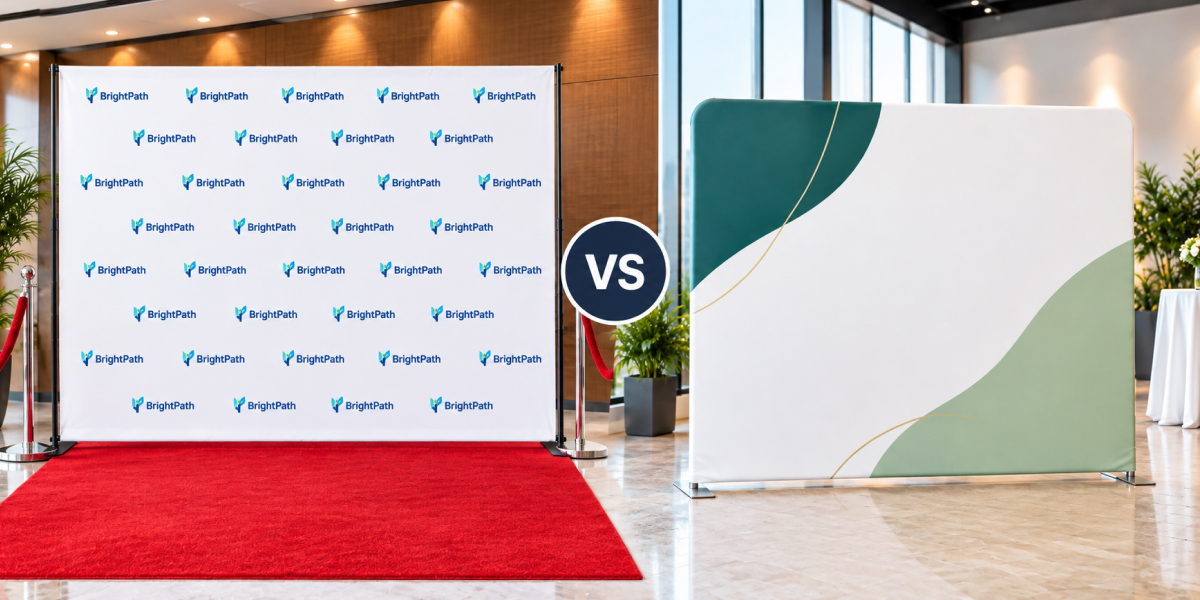
The step-and-repeat display typically fits best in situations where there is a need for repetition of logos, visibility of sponsorship, and branding within the photographs taken. On the other hand, a tension fabric display uses wrinkle-free material to mount graphics. This can be used as a background for photography, presentations, exhibitions, and even larger events.
Choosing custom fabric backdrops for the event can make or break your eventful day. Just one wrong step can compromise your entire visual production and cause you to suffer from flash photography glare that will obscure your corporate sponsor’s logo, material sagging under the weight of venue lighting, or the assembling process taking too long and delaying your setup time. It all comes down to understanding how each choice measures up in terms of installation, transportation, storage, graphic flexibility, durability, and future re-use.
Step and Repeat vs. Tension Fabric Backdrop: What is the difference?
To make an informed decision for your event, you must first look past the printed graphics and examine how these two systems are fundamentally built. While they both serve more or less the same purpose of creating a clean, vertical wall to showcase your brand, they approach that objective from opposite engineering perspectives.
Let’s have a quick look at what exactly you are buying when you purchase either of them.
What is a Step and Repeat Banner?
A step-and-repeat backdrop displays the logo, name, or design repeated across the entire surface. This is the type of banner that you’ve most likely seen on the red carpet at awards, ceremonies, and press lineups. It is custom-designed for events where sponsor visibility needs to pop in every single photo.
The design is flexible enough that it can be made according to the branding of the event, sponsors, or marketing theme. These banners can be sized to fit almost any space, from the regular step-and-repeat wall up to stage backdrops.
Most of the time, the banner is accompanied by a stand or frame that supports the banner vertically. That’s what makes the step-and-repeat banner with stand such a readily acceptable setup. It is very simple to assemble, position, and dismantle.
Check out our blog to learn more about Step and Repeat banners!
What is a Tension Fabric Backdrop?
A tension fabric banner is different from the former in some ways. While a banner is hung on a frame, here a printed fabric graphic is stretched over a specialized frame in tension, almost like a canvas. That tension is what makes its surface free of wrinkles and smooth in contrast to vinyl.
As the frame has been designed in a way that it will disappear once the material is placed onto it, all the focus turns towards the graphic. This makes a tension fabric display a strong choice when the goal is one big picture, especially in spaces where a wall-like backdrop matters more than repeated logos.
The Fundamental Difference Between the Two
After stripping away the details, the two formats come down to this:
- Step and Repeat: A flexible banner graphic that is suspended inside an adjustable pole-pocket or telescopic stand.
- Tension Fabric: A form-fitting fabric graphic paired with a dedicated frame system.
The advantage of using a step-and-repeat backdrop design is that it allows for the graphic and the stand to be two separate elements. That’s exactly why it can be easily customized for every new event. The difference with a tension fabric design is that it is made up of a single component. Here, the fabric and frame work together to create one finished look.
So, the right choice for you depends on whether or not the backdrop is going to be moved, how it is going to be set up, and what kind of finishing look you are after.
Step and Repeat vs. Tension Fabric: Key Difference At a Glance
When selecting signage assets, you will require an immediate operational comparison to safeguard your investment. The table below provides an immediate performance comparison of all the options according to their appearance, photography, installation, mobility, outdoor use, personalization, and value for money.
| FACTOR | STEP AND REPEAT BANNER |
TENSION FABRIC BACKDROP |
|---|---|---|
| Graphic Appearance | Repeated logos, sponsor marks, patterns, or custom artwork. | Continuous graphic with a seamless visual presentation. |
| Visual Finish | Can show minor edge curling, wrinkles, or sagging. | Flawless, tight, and 100% wrinkle-free surface. |
| Photo Performance | Vinyl can reflect camera flashes, causing hot spots or glare. | Matte fabric backdrop for events completely absorbs light for glare-free photos. |
| Hardware Setup | Adjustable telescopic poles and base plates; frame is visible. | Snap-locking aluminum tube frame; completely enclosed by graphic. |
| Versatility | Frame adjusts to fit different banner sizes. | Frame is fixed; requires graphics made for that exact dimension. |
| Outdoor Suitability | Generally the more practical option when the banner material and support system are selected for outdoor conditions. | Better suited for controlled indoor environments, particularly where wind is not a concern. |
How Do the Two Backdrops Look in Professional Photos?
Selection of the surface materials affects camera sensors in all types of lighting conditions:
Appearance of Surface Material
The vinyl materials continue to be vulnerable to curling at the edges. Photographic backdrops made of fabric materials are taut in all directions to form a completely flat surface.
Flash and Studio Lighting
Strong flashes reflect off vinyl, eliminating any text components. The knitted polyester material used in fabric backdrops for photography eliminates any reflected light, thereby maintaining legibility.
Smartphones and Video Shooting
Mid-range phone cameras have issues with dynamic range when reflections come into contact with a custom step and repeat banner. Video production crews prefer tension systems due to the lack of micro-shadows produced by ambient lighting.
Logo Visibility & Wrinkles
The wrinkles prevent your logo from being correctly aligned. However, with a tension fabric banner, you are guaranteed to have no wrinkles at all because it tightens up the fabric like a drum.
When a Matte Fabric Surface Has An Advantage
Tension fabric displays have a smooth, matte finish. This is advantageous in cases where the display will be photographed using bright lights.
The use of a smooth, matte finish will help prevent any reflections from the flash used in photography. This ensures that the background is consistent during photography and does not create any bright areas that may overshadow the subjects in the photograph.
This would come in handy for the fabric backdrops for photography used in:
- Corporate photography shoots
- Press conferences
- Product photography
- Interviews
- Videos on social media
- Presentations at trade shows
When a Step and Repeat Banner Makes Sense for Photography
The step and repeat banner backdrop is always a perfect option to go for when brand identity is the prime focus of the photographs taken.
As discussed, here logos are repeatedly used to ensure that sponsors, firms, or other parties stay visible in photographs. Step and repeat banners are thus very useful at:
- Red carpet events
- Press conferences
- Award ceremonies
- Sponsor events
- Corporate events
- Media opportunities
Step and Repeat Banner vs. Tension Fabric for Event Branding
Usually, the biggest difference between these two backdrops comes down to how you want your branding to appear.
When Repeating Logos is the Main Goal
Step and repeat banners continue to be the most suitable choice for red carpet events, media days, and charity galas. The repeating design in these banners is an assurance that, no matter the proximity from which a photographer captures an image of a guest, there will be at least one fully visible sponsor’s logo in the background.
When a Full Custom Graphic Makes More Sense
A large graphic is always better when it comes to scenic stage background, immersive environment design, or an entire trade show backdrop. With a tension fabric display, abstract artwork, full background layouts, landscapes, and gradients can flow freely and seamlessly without being cut off by poles or joints. This makes it ideal for event-specific messaging.
Which Backdrop is Easier to Set Up?
Setting up the tension fabric backdrop is generally simpler and quicker, particularly when you work alone. Although the backdrop appears to be complicated and advanced, setting it up is extremely easy as opposed to manually adjusting the traditional step and repeat banner.
Why Tension Fabric is Relatively Easier
- Tool-free, Snap-together Frame: Aluminum poles have snap-lock connections (like in camping tent poles). You do not have to waste your time twisting thumbscrews and adjusting poles for leveling.
- The "Pillowcase" Graphic: The fabric graphic is made in one piece like a sleeve. You need to slip it on top of the frame and close it with a zip down from the bottom. The zipper will take care of tightening the fabric.
- No Need for Wrinkle Management: Since the fabric is tight, there is no need to worry about managing wrinkles or steaming out creases.
Why Traditional Step and Repeat Banners Take More Effort
- Sag Factor: As a result of their weight, making sure that the vinyl banners hang straight without sagging in the middle needs precise adjustment of the telescopic poles.
- Two-Person Job: Raising two adjustable poles together can be very difficult without a helping hand because there is always a possibility of the frame collapsing.
- Wrinkles and Creases: If the vinyl banners were folded or rolled up, there will be a need for much effort to ensure that all wrinkles are ironed out.
Choosing the Right Step and Repeat Stand Size
The size of the stand may determine how much space the step and repeat banner consumes and how much of the design is captured in pictures. Some of the common sizes are:
- 5 x 6 Step and Repeat Banner Stands: Ideal for small photo spots, small events, and individual or group photos.
- 5 x 8 Step and Repeat Banner Stands: An ideal choice for medium-sized photo spots, interviews, conventions, and branded events.
- 8 x 8 Step and Repeat Banner Stands: These will give you ample backdrop space for group photos, large events, and branded spots.
If a business has equipment that is compatible but just requires a new graphic, it can also consider the possibility of purchasing either the backdrop frame alone or a new banner. The compatibility of the graphic with the dimensions, attaching mechanism, and stand must be considered first before ordering.
Portability, Transportation and Storage: Which One is Easier to Move?
Portability is particularly significant when the same background setting for an event needs to move around from place to place at trade shows or any other recurring events. The main distinction is made in the way in which the graphics and equipment are packed.
| FEATURE | STEP AND REPEAT BANNER |
TENSION EVENT BACKDROP |
|---|---|---|
| Packed Footprint | It must be folded into rolls, whereas the frame should be packed separately. | The fabric can be folded, and the frame breaks down into smaller sections. |
| Transportation | Requires enough space for the folded graphic and supporting equipment. | Compact frame components and fabric can usually be carried together in a travel bag. |
| Carrying | Large banners can require more space and careful handling during transport. | Lightweight aluminum frame components are easier to carry between venues. |
| Storage | Should always be stored in rolled form, keeping the parts of the frame separate. | Fabric can be folded and stored with the disassembled frame and carry bag. |
| Storage Space | Practical when the same banner is being used repeatedly, and enough space is available for transport. | Well-suited to teams that regularly move displays between events. |
| Frequent Travel | Requires enough room for the rolled graphic and supporting structure. | Takes less space once the frame is disassembled and the fabric is packed away. |
What happens When Your Event Branding Changes?
The effects of your event branding change will depend totally on the framework of the backdrop that you have created in case there is re-branding of the corporate, change of event sponsors, or new messaging of the event. This is how it happens with each system:
The Transition for Step and Repeat Banner
Since the step and repeat backdrop is based on the suspension concept, the graphics are totally separate from the hardware.
- The Process: The old print of vinyl or fabric has to be disposed of, as it cannot be altered in any way. You have to get a brand new custom step-and-repeat banner printed as per your new logo grid.
- The Advantage: The system is very flexible. As long as you have the retractable step and repeat backdrop with stand, the telescopic poles can be adjusted. This indicates that the new banner does not have to be the same dimensions as the previous one. You can print a small 5 x 8 or large 8 x 8 banner and use the same frame.
The Transition for a Tension Fabric Backdrop
Since a tension fabric display relies on the fitting and pillowcase design, it is designed to function together with the graphic and frame as one piece.
- The Process: The aluminum hardware that makes up the structure will be an asset of your corporation forever. In the event that you change your branding, you won’t have to replace the entire system. All you have to do is get a new skin, which is commonly called the “graphics-only” print, and just replace it by zipping the old one out.
- The Advantages: The switch only takes a few minutes, and getting a new skin is much more affordable compared to purchasing an entire new backdrop system. But unlike telescopic systems, you are stuck with your original frame size (for example, a wall or Curved Tension Fabric Display).
Build the Backdrop Around the Way You Will Use It
The proper choice of custom event backdrop is the one that meets the requirements of the job. A sponsorship wall, photo background, or trade show exhibit will likely have different requirements from an advertising backdrop, which may need graphics updated regularly. This will be clearer if one first establishes the objectives of the display and then compares the alternatives.
Printing Limitless provides both step and repeat backdrops and tension fabric displays, allowing you to have the freedom of choosing a branded event backdrop according to your event needs rather than adjusting the event around the display. In addition to these, you could also check out our custom backdrop with stands, replacement graphics, and various types of displays as per your needs.
If you are still not sure about your choices or want to go through all the available options, you can check out our Printing Limitless website and view our available backdrops for your events.